PayPal DonationsDonate to the Lodge easily and conveniently!

How to Scan a QR Code
1. Open the camera app on your phone.
2. Hold your device over the above QR Code so that it’s clearly visible on your smartphone’s screen.
3. Presto! Your smartphone reads the code and navigates to the lodge PayPal donation destination.
Or you can click the QR code to be redirected to the PayPal donation destination.
Monthly Lodge BreakfastJoin us for our monthly lodge breakfast every first Saturday of the month.

Our Lodge HistoryHistory of Yucca Valley Lodge #802 F&AM
Before WWII, Yucca Valley was primarily ranchland and some homesteads. It was popular with people suffering from lung ailments and arthritis, but there was not enough here economically to grow a city. Residents looking for work generally went “down the hill.”
After World War II, however, the economy of Yucca Valley boomed. People began looking for retirement or vacation homes away from the smog and problems of cities. Because the water was more readily available in Morongo Valley and 29 Palms those areas grew first. The real trigger was the Marine Corps Base replacing the Navy Glider Base, and both Twentynine Palms and Yucca Valley blossomed.
Freemasonry experienced a similar growth surge following WWII as well, which ultimately led to the formation of our Lodge. Veterans were looking for the comradery of fraternal organizations and found Masonry. Veterans, retirees, escapees from the cities and active-duty members of the armed forces who were already brother Masons in the local area found each other.
On March 10, 1956, a group of Masons got together to form an unofficial Masonic Club, dubbed the Desert Sojourners Club. The first meeting of the club was on April 13, 1956. The club met initially at the Community Hall in Joshua Tree, CA, but they knew they needed their separate Lodge building.
So, on January 11, 1957, a building committee was formed to find an appropriate site in Yucca Valley for a Masonic Temple, which became the Desert Sojourner’s Club, Inc. That site was found and is the current Lodge grounds.
In April 1958, the lot was cleared for preparation of the Temple, plans were drawn up, permits were granted, and the ground was broken on July 18th for the foundation. While constructing the Temple, the Yucca Valley Masonic Club was officially formed in June 1959.
The construction of the Temple was donated with over 3000 hours of donated working hours, it being deemed the Sojourner’s Building. The building was completed on January 9, 1960. Afterward, the Club requested permission of the Grand Lodge to become a Lodge.
The Grand Master of California, the Honorable Joe L. Shell, granted permission to the Yucca Valley Masonic Club to form a Lodge in May 1960, becoming Yucca Valley Lodge U. D. (Under Dispensation) instituted June 11, 1960.
The initial membership of the Lodge was 47 Charter Members. The first Master of the U.D. Lodge was Clarence E. Miller, who turned over the Master’s position to Louis L. Cunningham after a few months.
Disaster struck when a fire nearly destroyed the Sojourner’s Building on April 5, 1961, gutting the building and causing over $25,000 damage. In today’s dollars, that would be $177,321.00! Insurance covered the loss and rebuilding began in earnest.
The Lodge was granted its charter on October 11, 1961, to form a Lodge from the Yucca Valley Masonic Lodge U.D. to become Yucca Valley Masonic Lodge #802 F&AM (Free and Accepted Masons)
On February 26, 1963, the Yucca Valley Masonic Lodge Temple Association accepted the ownership of the Sojourner’s Building as the Temple for the Lodge.
Of particular note, on March 2, 1968, Masons from the Lodge laid the cornerstone for the Yucca Valley High School, which was attended by 22 California Grand Lodge Officers. This began the YV Lodge’s long association with public schools.
On May 16th, 1974, a ceremonial burning of the Temple’s mortgage was held, which was attended by over 100 people and celebrating 14 years of efforts and payments.
The Lodge has been in continuous operation ever since, waxing and waning with the times, having a current membership of about 50 members.
The Worshipful Master’s Masonic Library
Click Here to view are over 400 works of Masonic Literature.

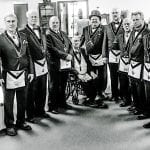
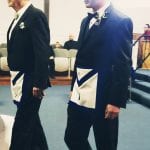
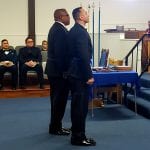
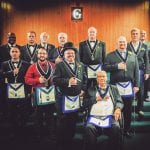
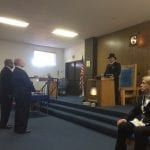
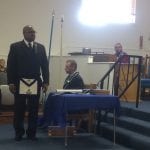
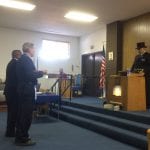
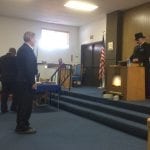
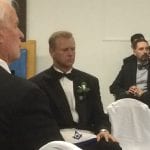
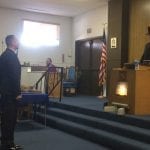
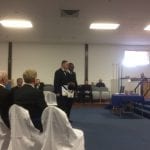
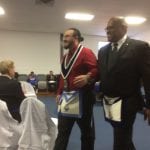
Lodge 802 Installation Photos
Masonic Short Talks
What kind of Mason are you?
Did you ever consider that there’s more than one kind of Freemason? The easy answer is, “sure”. We’ve chided about “magic masons” who get a ring and disappear, or about “supermen” who carry a lodge on their shoulders like Atlas carrying the world, and other varieties. However, what I’m speaking of are the two types discussed by Albert Mackey, esoteric and exoteric.
What are they, you ask? Good question! Let’s discuss the two terms:
esoteric and exoteric.
Exoteric refers to the instruction given to the general public, which is only surface deep and only addresses the most basic of explanations of the hidden mysteries of Freemasonry.
Esoteric refers to the more obscure tenets of the Masonic philosophies, which are reserved for those with an innate intellectual curiosity and who will peel back the layers to discover lessons too deep to be appreciated by the casual, or surface, student of the mysteries.
I remember when I was a new Entered Apprentice and Fellowcraft thinking, “when do I learn those secrets that I’m being obligated to keep secret”? It seemed everything I was learning in my proficiencies were open information (except the modes of recognition). I thought, “what’s the big deal”? At the time, I was an exoteric Mason. However, I wanted to know more. I wanted to peel back the layers and find out what the adepts of the fraternity knew but were not yet shared. This led me to many years of study, thought, contemplation, and discussion.
The system, as Mackey says, is esoteric in its construction and is only bestowed to those who delve into the teachings beyond general education. It is voluntary education, dependent solely of the will of the student with the consent of the instructor. Every Mason, however, enters the fraternity as an exoteric Mason, and is superficially educated through materials available from his lodge or the grand lodge, and is generally made to satisfy the casual Mason. Most of our brothers remain thus, fully satisfied with superficial Masonic knowledge and rudimentary application.
There are those others though, whose curiosity is not easily sated, and who desire a more intimate knowledge, understanding, and application of Masonic tenets. Those men follow the trails, search the perimeters, explore hidden recesses, and contemplate the entire Masonic edifice. They are the esoteric Masons, whose light shows through in their thoughts, ideas and actions.
They will then guide and instruct others who have the same intellectual curiosity. The hidden lessons of the order become familiar to them and become an integral part of their personae. As Mackey says, “As we cultivate it as a science its objects become extended-as our knowledge of it increases, new lights burst forth from its inmost recesses, which to the inquisitive Mason, burn with bright effulgence; but to the inattentive and un-searching, are but as dim and fitful glimmerings only rendering ‘darkness visible’.”
Every Mason should decide for himself which school he will become a part of, and pursue accordingly. Will he study the hidden beauties and sciences?
Will he explore the rich history and meanings of Masonic symbology? The rewards are great, but the work is long and deep and rich in refreshment.
I, for one, after 11 years of study still burn with the desire to learn more and improve myself in Masonry. Do you? Are you esoteric or exoteric?
Written by Brother TC Dowden, PM
Being or becoming Honorable – The Better Man
We have previously discussed what it mean to make a good man better. Most of the lessons of the first degree, which is designed to give to the candidate the tools of shaping a better man, are presented in the lecture and in the charge. I would argue that the shaping of a good man into a better man is the process of him being or becoming honorable.
What does it mean to be honorable? Is it just a title, like that we give to elected officials? Is it self-bestowed? Or… is it a condition or consideration bestowed upon a man through his actions and interactions?
If you answered with the latter, I believe that you are right in our teachings. While Webster defines honorable in two ways: (1) being worthy of honor, and (2) as a title indicating eminence or distinction, as Masons we focus on the first definition, being worthy of honor. The quality or word honorable has to do with people and actions that are honest, fair, and worthy of respect. An honorable person is someone who believes in truth and doing the right thing — and tries to live up to those high principles.
For a man to be deemed by others as honorable, he should be morally correct, honest, ethical, principled, right-minded, caring, and full of integrity.
Morally correct– this quality addresses knowing and doing what is right and correct. If what you intend to do or get is within the law and does not hurt another person, then it can be deemed to be moral. If what you intend to do is in accordance with fact or truth, free from error, then it is correct. Don’t lie, cheat, or steal or get something or someone that is not earned or deserved. Work for what you want, and give appropriate effort in your work.
Honest– speak and follow the truth, not relative truth. Don’t be deceptive, wearing a false mask. When it comes to honor, it’s important to be authentic. Show the world who you really are, even if it come at the expense of your reputation for being “nice.” To be honorable, you’ve got to be trustworthy. Can you tell the truth most of the time and be considered honest? Is there a sliding scale to honesty?
Ethical– being ethical can be thought of as following your values. Your values are what you turn to for answers when there’s no one else you can ask. What do you believe in? In any given situation, how do you decide what’s right and what’s wrong? Having strong values is key to being honorable, since acting with honor means doing the right thing, even if others disagree with you. Being ethical also means knowing, understanding and respecting boundaries set by society, by groups, or by your life-partner. Do you see rules as mere suggestions, or as guidelines and standards?
Principled– Follow and defend what you believe in, stand up for your values. Walk your talk. Being principled also means that you don’t have ulterior motives. If you’re principled, you help people because you care, and you don’t expect to get paid back. When you do something kind, there’s no self-serving motive behind it; you’re driven by love. Think about the decisions you make every day, and decide what powers them. Only youknow whether your interactions are tainted by motives you don’t want others do see.
Be Right-Minded– Don’t manipulate people. Part of being honorable is acknowledging the effect your words and actions have on other people. You have the ability to help, and you have the ability to hurt. Don’t mess with people’s emotions as a way to get what you want. Don’t take advantage of other’s weaknesses. Don’t be controlling, allow others to make their own decisions. Don’t lay a guilt trip on people to manipulate them. Importantly, don’t lead people on by making them think you’re more emotionally involved than you really feel.
Caring– Come to the aid of people, especially your brother Mason and his family, without regard to reward. True honor is demonstrated when you’re called upon to do something you really don’t want to do, and you do it anyway because it’s the right thing to do or because your brother is in need. Caring is also having due regard for the difficulties of others, knowing when they have reached their limits and honoring those limits or limitations.
Integrity– Do what you say you are going to do. If you’re constantly backing out of social plans, or not showing up when you said you’d help out, work on your follow through. Other people learn to depend – or not depend – on your words. Do your actions meet your words? A “little white lie” makes you less trustworthy in others’ eyes, and before long people won’t consider you reliable at all. Doing what you say you’re going to do, no matter how small, builds character and develops your sense of honor. More so, it creates an aura of honorability for you in others.
Brothers, we know our principle tenets: Brotherly Love, Relief, and Truth. We know our four cardinal virtues: Temperance, Fortitude, Prudence, and Justice. And our EA Charge admonishes us to regard the VSL as the unerring standard of right, to therefor regulate our actions to its precepts. We are taught to act upon the square to others, render them kind office with justice and mercy. Practice the public virtues, let Temperance chasten, Fortitude support, and Prudence direct us, and finally, to let Justice be our guide in all our actions. Doing so, living the precepts of Freemasonry, creates a better man, and when you do, you will be deemed by others and by the GAOTU to be honorable.
Written by Brother TC Dowden, PM
Masonic Education – Brotherly Love
Brotherly love is love of our fellow man regardless of race, color, creed, or station. I am sure all will agree that this principle is not practiced to the extent that it should be in the world today, but were it practiced to its fullest, all the bickering, squalor, and misery would soon disappear. In a Lodge, a man need no longer be a stranger; he finds there are other men, who, like himself are eager to establish friendships, engage in social intercourse, and pool the resources of all for the needs of each.
What should we do to turn a stranger into a friend? How do we greet new men? Do we judge their attire, looks, or social standing? What are we (as a Lodge) doing now and what should we be doing in the future?
The fraternal tie redeems a man from loneliness and a sense of helplessness. In the fraternal circle is the warmth and security which a man needs. Brotherly love is the substitution of a friend for a stranger, it is a spirit that puts around a man the comforts and securities of love. When a worthy Brother in distress is helped, it is not as a pauper, as in the cold fashion of public charity, but the kindly help which one neighbor is always glad to extend to another. Masonic charity is strong, kindly, and tender; and not charity at all in the narrow grudging sense of the word. Friendship, fraternity, fellowship; these are the soul of Freemasonry.
What are we doing to reach out to our brothers in the Lodge? How do we assist them when we don’t know them?
The Mason, who understands that brotherhood is but one form of wisdom, and that it is necessary in the world today, will not be troubled by sentimental difficulties. Neither will he permit a few accidental private experiences to sour him of all brotherly striving. It may be that my neighbor and I have natures that are entirely different: what I admire he detests, what I love he hates. Perhaps my vocation is one that is opposed to his interests. It may seem that we cannot hold social intercourse because we have too many differences. Such a thing has nothing to do with Masonic brotherhood! Brotherhood does not demand that we privately like people who are obnoxious to us, or that others should like us who find our company distasteful. Such things are of one’s intimate likes and dislikes and have to do with private friendship rather than brotherhood.
Do you avoid a brother because of petty differences? Do you call out a brother on your differences or seek commonalities to build upon? Can you find an interest that you both can share? Can you let go of prejudices or preconceived notions?
What We Can Do as Masons
- If I cannot like this neighbor of mine, I can still be a brother to him.
- I can give him exact and impartial justice in all my dealings with him.
- I can refuse to do evil to him, or speak evil of him; I can always maintain an attitude of good will to him, and wish for him good fortune and happiness.
- I can stand ready to help him to the fullness of life so far as circumstances make that possible, and I can always refuse to place any obstacles in his way.
- If I have any difference with him, I can differ as one man to another, honestly and openly, without argument.
Adopting such an attitude as is stated above is the Brotherly Spirit, and it can flourish even when private friendship is not possible. This, my brothers, is Brotherly Love.
Written by Brother TC Dowden, PM
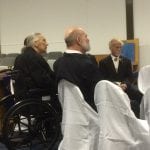
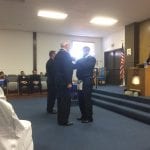
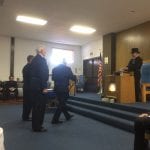
30th Annual Public Schools Appreciation Night2019 was a particular year for the lodge and the community as it marked the 30th anniversary of public schools appreciation. Each year students and teachers are recognized with the prestigious masonic cornerstone award for their exemplary hard work and superior citizenship throughout the school year in front of their families, friends and local officials. We intend to continue the tradition for many years to come.
[powr-banner-slider id=628a9c56_1555192573172]
Congratulations to all the recipients of this year’s Harry S. Tanzer Cornerstone Award of Excellence!
Black Rock High: Jessica Gutierrez Becerril, Angela DiGangi, Noah Egli, Timothy Ligon
Staff Member: Julie Alexander
Friendly Hills Elementary: Elijah Lopez, Rileigh Marriott, Angelina Dennis, Caleb Murphy
Staff member: Debbie Jenson
Joshua Tree Elementary: Allisa Pincott, Rocker Ross, Cona Daggett, Peytin Boley
Staff Member: Matt Delgado
La Contenta Middle School: Landon Finnicum, Lorna Phillips, Angel Sanchez, Devin Spitz
Staff member: Lori Thomas
Onaga Elementary: Jasmine Bechert, Brody Herrera, Shawn Harper, Kaitlynn Russell
Teacher: Bryan Sullivan
Landers Elementary: Adrian Tamayo, Skyler Nauman, Yahaira Alvarenga, Jenna Tipton,
Staff: Carolyn “Grandma” Willis
Morongo Valley Elementary: Emett Cullity, Eva Vrhovnik, Evelyn Nava Gutierrez, Zayden Austin
Teacher: Laurie Klimowicz
Yucca Mesa Elementary: Morgan Miller, Timothy Fulkerson, Samantha Reynolds,
Alivia Chartier,
Staff: Nicola Philippi
Yucca Valley Elementary: Sahej Ladhar,
Zyn Ferrer, Jack Youngman, Jessie Hendrickson
Staff member: Terry Spurrier
Yucca Valley High School: Sierra Rogers,
Marissa Lindley, Robert Manaco, Daniel Goddard
Teacher: John Frakes (Honoring memory of)
Trestleboard ArchivesMASONIC TRESTLEBOARD_August 2018
MASONIC TRESTLEBOARD_September 2018
MASONIC TRESTLEBOARD_October 2018
MASONIC TRESTLEBOARD_November 2018
MASONIC TRESTLEBOARD_December 2018
MASONIC TRESTLEBOARD January 2019
MASONIC TRESTLEBOARD_February 2019
MASONIC_TRESTLEBOARD_March_2019
MASONIC TRESTLEBOARD_April 2019
MASONIC TRESTLEBOARD_May 2019
MASONIC TRESTLEBOARD_June 2019
MASONIC TRESTLEBOARD_July 2019
MASONIC TRESTLEBOARD_August 2019
MASONIC TRESTLEBOARD_September 2019
MASONIC TRESTLEBOARD_October 2019
MASONIC TRESTLEBOARD_Noveber 2019
MASONIC TRESTLEBOARD_December 2019
Trestleboard January 2020
High Desert Trestleboard February 2020
High Desert Trestleboard March 2020
High Desert Trestleboard June 2020
Facility Rental
INTERESTED IN RENTING OUR FACILITY?
Email now for inquiries:
asecretary802@gmail.com
Whether you’re hosting a family reunion, trade show, corporate event, or class – the Yucca Valley Masonic Lodge makes a great location at an affordable price.
The hall can be configured for formal dining, or broken down to a large open space. We have both round and rectangular tables, chairs and a very large parking lot.
If you’re looking to hold a multi-day event, weekly or daily classes, the Yucca Valley Masonic Lodge will be happy to negotiate an affordable contract.
Looking for a venue? Here are a few things people use our Lodge for:
- Parties
- Reunions
- Corporate Meetings & Retreats
- Dance Classes
- Fundraising Dinners
- Concerts
- Community Theater
- Exercise Classes
- Trade Shows
Email now for inquiries: asecretary802@gmail.com
High Desert TrestleboardThe monthly High Desert Trestleboard covers both Yucca Valley Lodge #802 and Oasis of Mara Lodge #735 from Twentynine Palms and includes the most recent information regarding both lodge’s activities and calendar.
Trestleboard May 2022